
Rewriting the Rules of Public Markets
The story of how LTSE petitioned the SEC and sparked a national conversation about the role of quarterly earnings reporting in public markets.

The Wall Street Journal Reports: LTSE Petitions SEC on Earnings Reporting Frequency
On September 8, 2025, major financial media picked up the story bringing LTSE's case directly to those who need to hear it.
The Wall Street Journal covered LTSE's petition as a concrete regulatory challenge to one of the most deeply embedded practices in American public markets — arguing that companies should be allowed to share results less frequently not to obscure performance, but to reorient decision-making toward long-term growth. Media visibility matters in rulemaking, and WSJ coverage signals exactly the kind of public and market-participant interest that compels formal SEC response. The story marked the moment LTSE's effort moved from regulatory filing to national conversation.

"The proposal would give public companies the option to report results twice a year, helping executives focus on long-term goals rather than quarterly targets."
The Wall Street Journal, September 2025
Jeenah Moon/Reuters
LTSE Files a Formal Petition to End Mandatory Quarterly Reporting
Filed with the SEC in September 2025, the petition acted as a direct challenge to one of Wall Street's most entrenched norms.
LTSE formally petitioned the SEC to amend quarterly reporting requirements under the Securities Exchange Act of 1934. Designated Petition 4-872 on the official rulemaking docket, the filing argued that mandatory quarterly earnings creates structural short-termism — and called for making quarterly reporting voluntary while preserving all existing material disclosure requirements. It was the starting point for a national policy debate that would reach regulators, newsrooms, and television studios within months.
The U.S. Securities and Exchange Commission (SEC) announced that it is proposing a rule to allow public companies the option to report earnings semiannually instead of quarterly.
LTSE Brings the Case for Semi-Annual Reporting to CNBC
On September 18, 2025, LTSE made the case in real time for why the quarterly cycle is broken and what comes next.
The Long-Term Stock Exchange CEO Bill Harts took the exchange's advocacy directly to CNBC to make the case for why the quarterly reporting requirement trains companies to optimize for the short term at the expense of long-term value creation. His argument was clear: companies deserve credit for the work they're doing now — not just for hitting a number every 90 days. The interview put a human, executive voice behind what had been a regulatory filing, and helped build the public momentum needed for the SEC to act.
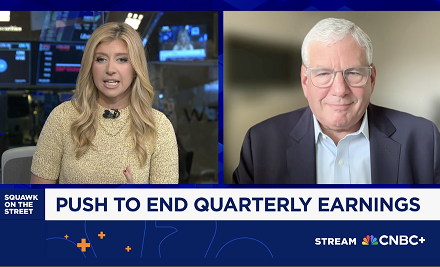
A Conversation About The Renewed Bid to End Quarterly Earnings Reports.
The Long-Term Stock Exchange
The SEC Advances LTSE's Petition to the Proposal Stage
The SEC announces it is formally proposing a rule to make quarterly reporting voluntary.
On May 5, 2026, the SEC announced it is formally proposing a rule to make quarterly reporting voluntary rather than mandatory — a direct result of LTSE's September 2025 petition. The proposal opens a 60-day public comment period and would lift the structural pressure that forces companies to manage every decision around a 90-day window, while keeping all existing material disclosure requirements fully intact. The reform marks one of the most consequential shifts to U.S. reporting structure in decades, and could make public markets significantly more attractive for companies looking to go and stay public for the long term.

“This is an important step toward modernizing market structure to better support long-term value creation.”
The Long-Term Stock Exchange