


Under Pressure: Balancing Short-Term Moves With Long-Term Goals
Why Strategy Horizon Is Emerging As A Defining Advantage In An Era Of Accelerating Change.
A Corporate Board Member / Long-Term Stock Exchange Report
Download the Report
report Overview
Measurable differences in confidence and behavior
A year-long research study by Corporate Board Member (CBM) and the Long-Term Stock Exchange (LTSE) finds that while America’s executive suites still believe in long-term strategy, most are operating within planning windows, board agendas and investment rhythms that make long-term value harder to protect.
The data indeed suggests short-term pressure is reshaping capital allocation, AI investment and strategy conversations, as most companies now operate within short-term strategic horizons.
But a small group is behaving differently—and reporting measurable differences in confidence and behavior.


Long-Term Mindset
83 percent of companies operate within a five-year strategy horizon or less.
Future Competitiveness
Companies with stronger long-term orientation report higher confidence in future competitiveness.
AI Integration
They are 20 percent more likely to integrate AI into long-term strategy and prioritize scenario planning.
Risk Identification
They are also more likely to identify emerging risks, including geopolitical disruption.
01 introduction
The importance of long-term strategy
A year of surveying CEOs and board members reveals a consistent pattern: Companies recognize the importance of long-term strategy, but short-term pressures are increasingly shaping how decisions are made.
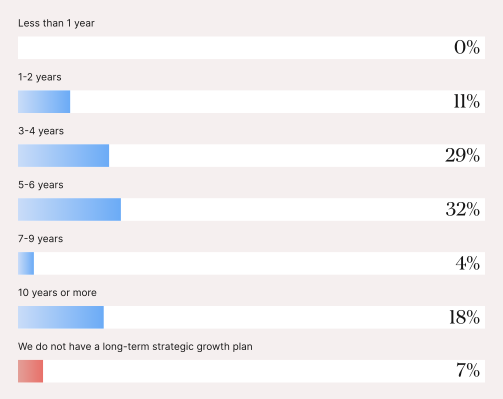
Economic volatility, shareholder expectations and rapid technological change are forcing leaders to make near-term decisions with long-term consequences. As a result, 83 percent say their company’s long-term strategy now covers five years or less, while just 17 percent say it extends beyond five years.
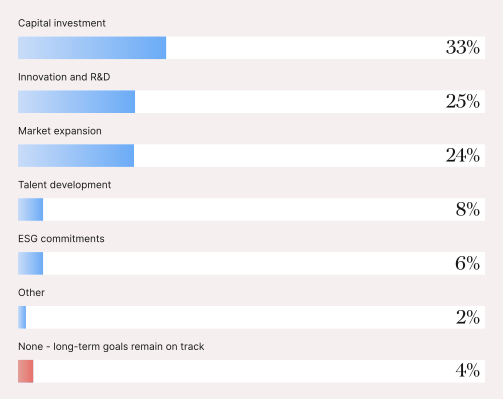
Those pressures are already affecting what companies protect and what they defer. Among public company board members, 33 percent say capital investment is the long-term priority most at risk from short-term pressures, followed by innovation and R&D (25 percent) and market expansion (24 percent).
The contrast across companies is clear: Those that embed a long-term focus across stakeholders, strategy, compensation, governance and investor engagement approach decision-making differently. They are more likely to maintain strategic focus under pressure, sustain investment in long-term priorities and navigate disruption with greater confidence.

how we measure
How We Measured Long-Term Orientation
Our analysis segmented respondents based on long-term orientation using a model that evaluates 16 signals from third-party evaluations and direct company behaviors related to strategy and stakeholders.
Companies are scored on a scale of 0–100, with only 10–15 percent of publicly traded companies achieving moderate to high scores. This analysis is based on the LTSE Long-Term Company Score℠.


Long-term value creation
“What stands out across this research is not a lack of long-term intent but a growing gap between intention and execution. Companies are navigating the same pressures, but those with stronger governance, clearer long-term strategy and alignment across stakeholders are better positioned to stay focused on long-term value creation.”
Chief Executive Officer | Chair of the LTSE Group Board | The Long-Term Stock Exchange
02 pressure and tradeoffs
Short-Term Pressure Is Hitting Long-Term Investment
Short-term pressures have already begun reshaping company priorities.
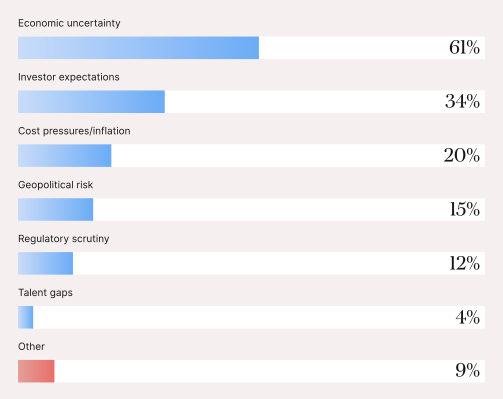
Six out of 10 business leaders in the U.S. identify economic uncertainty as one of the biggest pressures on their company. A third point to investor expectations, followed by cost pressures and inflation (20 percent), geopolitical risk (15 percent) and regulatory scrutiny (12 percent).
For boards and public company leadership, investor expectations are not just another source of pressure; they shape how short-term performance is evaluated and how much flexibility management teams have to sustain long-term investment. As a result, decisions around capital allocation, reporting cadence and strategic pacing are often made within the context of how they will be received by the market in the near term.
These pressures vary by sector. Industrial and manufacturing leaders are more likely to cite cost pressures and inflation as primary concerns, while technology and services leaders point to investor expectations and market volatility.
But across sectors, the effect is consistent: Pressure is driving real tradeoffs.
These pressures are not affecting all priorities equally; they are falling most heavily on investments tied to future growth.
Capital investment, innovation and market expansion emerge as the areas most at risk, suggesting that near-term demands are being managed by deferring the very capabilities most likely to shape long-term competitiveness. Over time, these tradeoffs can compound, making it more difficult for companies to sustain growth, adapt to disruption or maintain competitive positioning.
Only a small minority of leaders say their long-term plans remain fully on track, reinforcing how widespread these tradeoffs have become.
That uncertainty is reflected in leaders’ confidence in their ability to remain competitive over the next three to five years, which averages 6.9 out of 10—suggesting a level of cautious confidence despite the scale of disruption and tradeoffs described.
In response, boards and leadership teams are adjusting capital allocation strategies, with 33 percent identifying capital allocation as the primary lever they are using to navigate short-term pressure.
Short-term pressure is not just noise; it is falling most heavily on the investments most likely to shape future competitiveness.
Urgent Matters
What do you see as the greatest short-term pressure on your company today?
Delaying Growth
Which of the following long-term priorities do you believe is most at risk due to short-term pressures?

03 AI and long-term vision
AI Is Exposing The Gap Between Intent And Investment
AI is adding a new layer to this dynamic, highlighting the gap between near-term action and longer-term expectations.
Leaders’ expectations for AI diverge sharply depending on the time horizon.
- In the near term, AI is largely seen as manageable, with its impact concentrated in shifting roles and skills rather than reducing headcount.
- Over longer horizons, however, expectations shift significantly, with many anticipating meaningful workforce reduction within the next three to five years.
Despite those expectations, investment and integration remain incremental. Most companies are making measured investments in tools and infrastructure, while fewer are embedding AI as a core driver of competitive advantage.
Investment in workforce transformation also remains lower than investment in enabling technologies.
The result is a widening gap between how transformative AI is expected to be—and how aggressively companies are positioning themselves for it.
Sector differences are also pronounced. Technology and financial services firms report more active investment, while industrial and consumer-facing companies describe their approach as incremental or exploratory.

Improving the strategy you have
“CEOs and Boards should consider how AI can improve their strategy or accelerate things that may not have been possible before. Rather have an AI strategy, ask how AI can improve your strategy and what risks it creates through improper use or competitors using it better than you.”
Corporate Director, Multiple Boards; Former CIO, Microsoft


Creating the future
“The best time to innovate is when chaos has paralyzed the competition. Jack [Dorsey] and I launched Square in the midst of the 2009 recession and had our pick of talent and empty office space. It’s a pattern: Stuff happens and people freeze, but the few who don’t create the future.”
Co-founder, Square; Author The Innovation Stack
04 long-term strategy
Speaking Long-Term But Acting Short
Boards are not ignoring long-term strategy. After all, they have a core duty to ensure their company’s growth and sustainability over time. Boards are actively trying to connect short-term performance with long-term strategy, but how time is allocated suggests a structural imbalance:
- 25 percent of meeting time is spent on strategy and long-term positioning
- 36 percent is spent on operational and financial performance
A large share of boardroom time remains focused on operational and financial performance. The result is not a lack of attention to the long term, but a persistent tilt toward the immediate in how decisions are reviewed and discussed.
For boards, this imbalance is not simply observational, it is structural. Agenda design, time allocation and the framing of discussions are within the board’s control, making them central levers in whether long-term priorities gain traction or remain secondary to near-term performance.
Michelle Greene, board member, president emeritus and former interim CEO, Long-Term Stock Exchange, says the issue isn’t that boards lack awareness of the long term but how to operationalize it in the boardroom.
“When agendas are dominated by near-term performance, long-term priorities can lose traction,” she says. “Sustaining that focus requires a deliberate, integrated long-term approach to stakeholders, strategy, compensation, governance and investor engagement. Together, these principles reinforce one another and enable sustained commitment to long-term strategy through periods of pressure.”
Directors have reported taking some action to help redirect that focus:
- 71 percent use dedicated long-horizon strategy sessions
- 49 percent emphasize long-term expertise in board composition
- 39 percent track long-term performance alongside quarterly metrics
- 31 percent tie compensation to performance periods of four years or more
But these practices are not universal. Only 19 percent use scenario planning beyond five years.
Private Vs. Public
Which of the following mechanisms do you use to ensure that despite short-term pressures your company doesn’t lose sight of its long-term goals?
Scroll horizontally to compare private and public companies →
Private Companies | Public Companies | |
|---|---|---|
Dedicated executive sessions focused on the long-horizon strategy | 86% | 71% |
Multi-year capital-allocation frameworks | 39% | 38% |
Long-term performance dashboards tracked alongside near-term metrics | 36% | 39% |
Executive compensation plans weighted toward 4-year + performance periods | 36% | 31% |
Regular scenario-planning exercises covering 5-year + time horizons | 25% | 19% |
Expertise requirements emphasizing long-term strategic thinking | 25% | n/a |
N/A (No mechanism, No long-term focus, etc.) | 7% | n/a |
Other | 7% | 7% |
*Respondents were asked to select all that apply.
Predicting instead of reacting
“Understanding context and trends is the critical thing that smart CEOs and boards do in successful companies. Most CEOs and their unquestioning boards do not look at the vectors at play and only focus on the moment, i.e. react rather than predict.”
Board Member, Survey Respondent
05 reporting and achieving
The Reporting Debate
As short-term pressure reshapes how companies allocate capital, prioritize investment and structure board discussions, it is also prompting a more fundamental question: whether the reporting cadence itself reinforces those pressures.
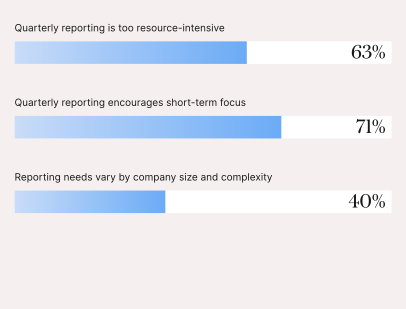
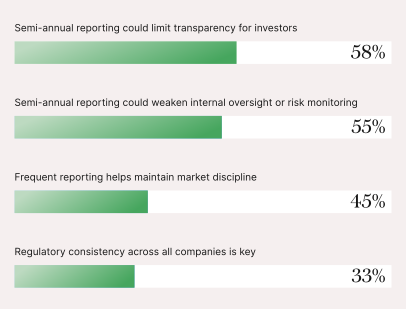
According to our research, views on reporting cadence are divided:
- 42 percent support allowing companies to choose their reporting frequency
- 39 percent favor maintaining quarterly reporting
But the debate is not just about frequency and its related costs; it reflects changing views on what reporting is at its core meant to achieve.
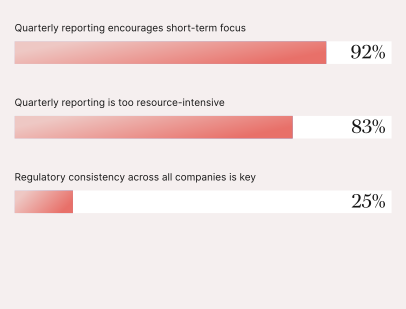
Leaders who favor more flexible or semi-annual reporting tend to see quarterly cadence as a driver of short-term decision-making and an operational burden, particularly for companies whose complexity or strategy does not align with a fixed reporting rhythm.
Those who support maintaining quarterly reporting emphasize a different set of priorities: transparency, internal discipline and consistent oversight. For this group, more frequent reporting is seen as a mechanism for maintaining accountability to both investors and management.
The contrast is especially pronounced among those advocating for a shift to semi-annual reporting, where the view that quarterly reporting reinforces short-term focus is nearly universal.
The implication is not that one approach is universally correct, but that reporting cadence has become a strategic choice rather than a fixed requirement. For boards, the question is whether current reporting practices are reinforcing long-term strategy—or unintentionally narrowing the company’s ability to pursue it. How that balance is managed is increasingly central to navigating sustained pressure.
Reporting Requirements
Public Company CEOs and Board Members’ Preference of Reporting Cadence
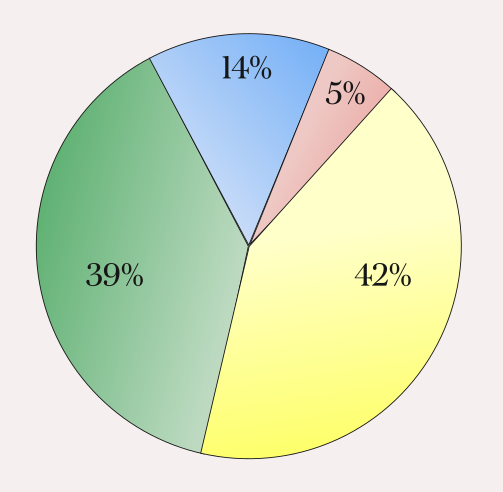
42% — Choose reporting frequency
39% — Maintain quarterly reporting
14% — Move to semi-annual reporting
5% — No preference
Reporting Cadence Preference Rationale
Of those in support of companies’ right to choose the reporting cadence:
Of those in support of maintaining a quarterly reporting cadence for all companies:
Of those in support of moving to a semi-annual reporting cadence for all companies:

Sustained commitment to long-term priorities
"When agendas are dominated by near-term performance, long-term priorities can lose traction. Sustaining that focus requires a deliberate, integrated long-term approach to stakeholders, strategy, compensation, governance and investor engagement. Together, these principles reinforce one another and enable sustained commitment to long-term strategy through periods of pressure."
Board member, president emeritus and former interim CEO, Long-Term Stock Exchange
06 longer-term orientation
Private Companies Show A Different Dynamic
Private companies appear to benefit from structural conditions that support longer-term thinking. They are more likely to operate with extended planning horizons and to reinforce that focus through governance, compensation and review cadence:
- 86 percent use dedicated long-horizon strategy sessions
- 36 percent tie compensation to four-year-plus performance periods
- 46 percent review long-term strategy quarterly, 32 percent annually
These structures do not eliminate short-term pressure, but they provide greater flexibility in how leaders respond to it.
For public company boards, this contrast highlights how governance structure and market expectations can shape strategic flexibility.
While public companies operate under different constraints, the comparison underscores the role of deliberate structures—such as planning horizon, compensation design and review cadence—in sustaining a longer-term orientation.
Long-Term Growth Planning
How many years into the future does you company’s long-term strategic growth plan cover?
07 The Five Principles Of
Long-Term Value Creation
Decades of research point to a consistent set of practices shared by companies that sustain long-term value:
Principle 1

Stakeholders
Consider a broad group of stakeholders and their role in long-term success
Principle 2

Strategy
Anchor decision-making in long-term priorities
Principle 3

Compensation
Align incentives with long-term performance
Principle 4

Governance
Maintain explicit board oversight of long-term strategy
Principle 5

Investor Engagement
Cultivate relationships with long-term-oriented investors

08 long-term horizons
What Longer-Horizon Companies Do Differently
Planning horizon is associated with materially different behaviors.
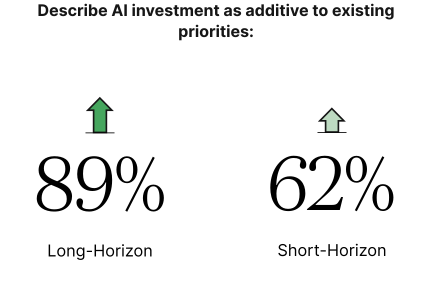
Companies with longer strategic horizons respond to uncertainty differently. Rather than treating emerging priorities like AI as tradeoffs against existing investments, they are more likely to position them as additive.
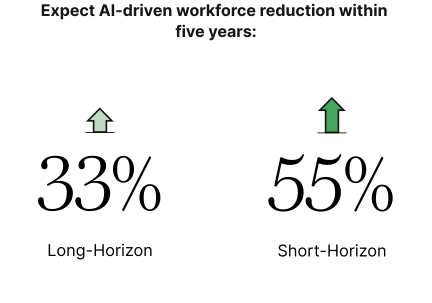
They also appear less likely to anticipate disruptive workforce reductions, suggesting a more gradual approach to transformation.
- 89 percent describe AI investment as additive to existing priorities, versus 62 percent of shorter-horizon peers
- 33 percent expect AI-driven workforce reduction within five years, versus 55 percent of shorter-horizon peers
These differences reinforce the role of planning horizon not just as a structural choice, but as a factor shaping how companies absorb and respond to change. While these patterns do not suggest a single model fits all companies, they do indicate that planning horizon is closely linked to how organizations absorb pressure and prioritize investment over time.
Once again, this varies by sector. Capital-intensive industries are more likely to maintain longer horizons, while technology and services firms operate within shorter windows.
Longer-horizon companies face the same pressures but appear better positioned to absorb them without abandoning their strategy.
long-horizon vs short-horizon
Long-Horizon Vs. Short-Horizon Company Views
09 effective long-term strategy
Conclusion
The research does not indicate that CEOs and boards have abandoned the long term. But it does show something more consequential: Most leaders believe in long-term strategy, but many are pursuing it within structures, reporting rhythms and planning windows that continue to pull them toward the immediate.
When the horizon is short, pressure is more likely to force tradeoffs between today’s demands and tomorrow’s capacity. When the horizon is longer, companies appear better positioned to navigate disruption without sacrificing future value.
For boards and CEOs, the question therefore is whether the organization is structurally equipped to deliver it. These are not abstract considerations; they are areas where board-level decisions and oversight directly influence how effectively long-term strategy is executed under pressure.
Practical Implications for Boards
The findings point to a set of practical implications for boards:
Whether board agendas meaningfully allocate time to long-term strategy
Whether capital allocation decisions reinforce or defer long-term priorities
Whether compensation and metrics align with multi-year outcomes
Whether the company has a structured approach to long-horizon scenario planning

Read More
Survey Insights





10 research methodology
Methodology
The research was conducted over a series of three surveys taking place in July 2025, November 2025 and April 2026. Invitations to complete the surveys were sent exclusively to CEOs and board members at U.S. public and private companies. The surveys were completed with the promise of confidentiality.
The demographics of the respondents are below.
Sectors | |
|---|---|
Construction / Engineering / Mining | 2% |
Energy / Utility | 6% |
Financial Services | 19% |
Healthcare | 8% |
Logistics & Transportation | 2% |
Manufacturing (Consumer Goods) | 6% |
Manufacturing (Industrial Goods) | 13% |
Pharmaceuticals, Life Sciences & Medical Products | 6% |
Professional Services | 4% |
Real Estate | 5% |
Retail / Trade | 6% |
Technology & Software | 12% |
Wholesale / Distribution | 2% |
Other | 8% |
Titles | |
|---|---|
Board Member | 36% |
Committee Chair | 32% |
CEO / President | 28% |
Chair / Vice Chair | 17% |
Lead Independent Director | 6% |
Executive Chair | 5% |
Size | |
|---|---|
$1 Billion or more | 41% |
$500 Million to $999.9 Million | 18% |
$250 Million to $499.9 Million | 9% |
$100 Million to $249.9 Million | 15% |
< $100 Million | 16% |
11 long-term partnership
About Us
Company Overview
Corporate Board Member, a division of Chief Executive Group, has been the market leader in board education for 20 years. The quarterly publication provides public company board members, CEOs, general counsel and corporate secretaries decision-making tools to address the wide range of corporate governance, risk oversight and shareholder engagement issues facing their boards. Corporate Board Member further extends its thought leadership through online resources, webinars, timely research, conferences and peer-driven roundtables. The company maintains the most comprehensive database of directors and officers of publicly traded companies listed with NYSE, NYSE Amex and Nasdaq.
Company Overview
The Long-Term Stock Exchange is the only SEC-approved national securities exchange built for boards and CEOs committed to strong governance and long-term value creation. In markets often driven by short-term pressures, LTSE helps boards and CEOs keep long-term strategy central to decision-making and align with long-term investors and other stakeholders who prioritize durability and provide patient capital.
Company Overview

Chief Executive Group exists to improve the performance of U.S. CEOs, senior executives and public-company directors, helping you grow your companies, build your communities and strengthen society.